
If you were driving along the Buckle By-Pass over August Bank Holiday you may have noticed a group of people in high visibility vests working on the steep banks of the cutting.
These were volunteers from Seaford Natural History Society and Butterfly Conservation, trying to remove Cotoneaster from the North bank.
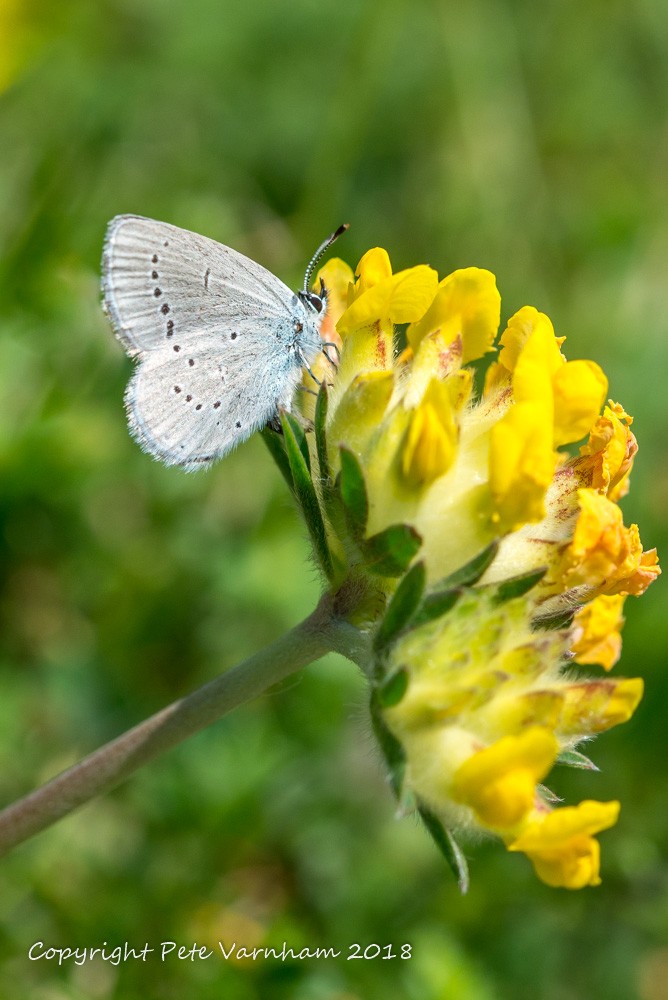
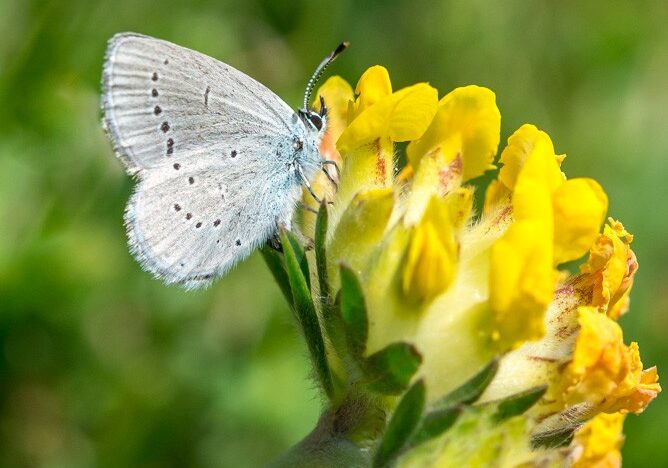
The Buckle By-Pass is registered as a ‘roadside verge of conservation value’ as it is home to several uncommon species, for example the Slender Hares Ear plant. Of particular interest to the volunteers working on the site was the Small Blue Butterfly, the smallest British butterfly with a wingspan of around 18-25mm. This pretty little butterfly is on the decline and is seen as a priority for conservation. It lives near Kidney Vetch, which is the food plant of its caterpillar, on chalk grassland and the South facing slope of the Buckle By-Pass is ideal. In the same area we have also seen another uncommon butterfly but in this case the Long-Tailed Blue is a migrant from Europe: taking advantage of the warmer weather, it has started visiting the South Coast and has been seen laying its eggs on plants on the Buckle By-Pass. These two uncommon butterflies (and many other insects) rely on native British plants and their existence is threatened by Cotoneaster .
Many people will be familiar with Cotoneaster horizontalis; it is a plant that can be bought in most Garden Centres. It has small, waxy leaves and in spring is covered in a mass of tiny pink or white flowers which in turn become brightly coloured berries in autumn. Cotoneaster was brought to the UK from Asia almost 200 years ago, but sadly it is highly invasive and because it isn’t a native plant it has no predators to control it. Birds feed on the berries carrying them out into chalk grassland where the plants grow and over the years the Cotoneaster has smothered many important landscapes. It’s impact on the countryside is such that Cotoneaster horizontalis is listed on Schedule 9 of the UK Wildlife & Countryside Act as an invasive species.
Much of the Buckle By-Pass is covered in Cotoneaster and other plants are unable to live under its dense foliage. If it is not removed then it will out-compete the food plants of our uncommon butterflies and they will become extinct in this area.
Every year in late summer volunteers scramble up the steep banks of the by-pass and remove as much of the cotoneaster as we can before the berries ripen, in the hope of slowing down its spread. Volunteers are also working hard on Seaford Head to try and stop Cotoneaster smothering our local nature reserve.
You can help by thinking twice about buying Cotoneaster for your garden, and if you already have it, perhaps you could replace it with a native plant that is not going to have a significantly bad impact on our lovely local countryside. We ought also to be putting pressure on the landscapers of new housing estates as they seem to be particularly fond of using Cotoneaster despite it being registered in the UK as an invasive species.
Another day of clearance is planned in the Spring – volunteers are welcome!
Our colleague, Paul Baker, who passed away last year, was one of the originators of the work party which does this work. Paul was also the driving force behind the recent renovation of the Dewpond at Seaford Head.
Jim Howell
Seaford Natural History Society