
A small but perfectly formed group of members combed the beach on a sunny but gusty morning.
Despite the low tide and previous rough weather, signs of life were hard to find and even the usual suspects of Slipper Limpet shells and Cuttlefish bones were scarce. Never the less, when we re-grouped at the Martello Tower café to inspect and discuss our finds we were surprised by just how much we had collected – 25 species of marine flora and fauna. (A full list can be found on the society website).
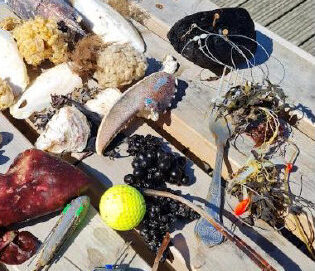
The photo (right) shows part of what we found.
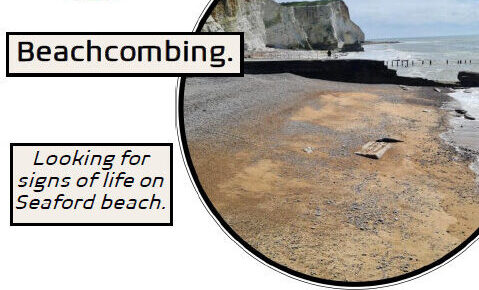
Catherine began by scrambling down onto the beach east of the Shoal and was rewarded with bits of several crustacean shells – she had prior knowledge of the best place to search! Meanwhile the rest of us worked our way along the shore, barely 400 yards from The Shoal to the Martello Tower, but hard going on the shifting shingle.
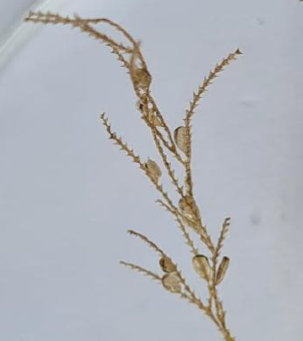
We were surprised to find only one Mermaid’s Purse, that of a Thornback Ray and pleased to be able to return the living Common Cuttlefish eggs to the sea. We found examples of all three types of seaweed, green, brown and red. What looked like a large piece of plastic turned out to be a red seaweed called Red Rags, Dilsea carnosa, apparently a characteristic plant of the kelp forest. Personally I was very pleased by the quality of the photo of the hydroid, Amphisbetia operculate, (below, right) taken with my smart phone.
There was very little litter, but we were disappointed to find two large lead fishing weights with nasty metal projections, hooks and nylon lines attached. On the other hand I imagine three holiday makers were upset have left the beach without the three pairs of spectacles that we found! Jane found a toy duck, correctly identified by iNatualist as a male Mallard – see if you can spot it in the photo.
All in all, a delightful morning and so agreeable to be able to sit and discuss our finds over a coffee on the beach.
Jenni Empson-Ridler, Seaford Natural History Society